
- 03214507000
- sultanulfaqr@tehreekdawatefaqr.com

- Home
- Tehreek Dawat e Faqr
- Founder
- Sarwari Qadri Order
- Publications
- Media
- Blog
- FAQs
- News
- Other sites
- Text Sites
- www.sultan-ul-ashiqeen.com
- www.sultan-bahoo.com
- www.sultan-ul-faqr-publications.com
- www.mahnama-sultan-ul-faqr-lahore.com
- www.sultan-ul-faqr-library.com
- www.masjid-e-zahra-khanqah-sultan-ul-ashiqeen.com
- www.khanqah-silsila-sarwari-qadri.com
- www.sultanulfaqr.com
- www.tehreekdawatefaqr.org
- www.sultan-ul-ashiqeen.pk
- www.sultan-bahoo.pk
- www.sultanulfaqr.pk
- Video Sites
- Text Sites
- Online Oath (Bayat)
- Contact
- Upcoming Events
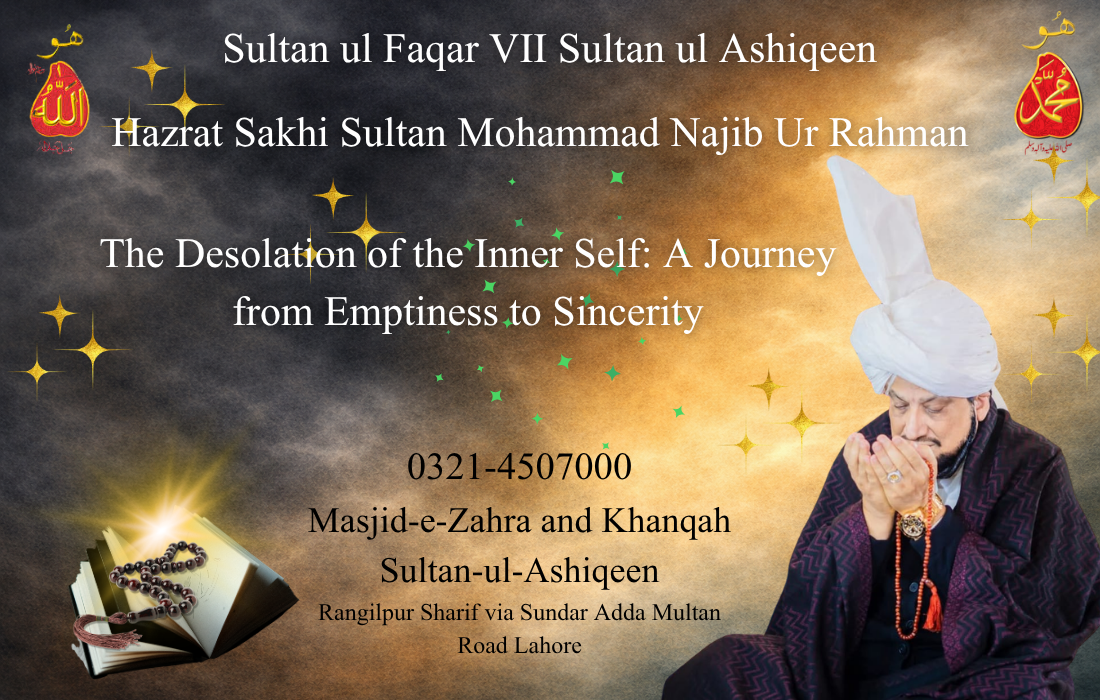
The Desolation of the Inner Self: A Journey from Emptiness to Sincerity
Understanding the Hidden Inner Reality
The most valuable possession held by a human being is not wealth, recognition, or status. Rather, it is the unseen inner world that shapes every action and intention. This hidden realm is often described as the Inner Dimension / Core, where sincerity, faith, and purpose quietly exist.
Although the Outward Appearance / Manifest Form of a person can easily be observed, the internal condition cannot be directly seen. However, it is within this concealed reality that the seeds of Spiritual Inanition are sometimes planted. Spiritual Inanition refers to a state of deep emptiness or exhaustion within a person’s soul, purpose, or inner life.
Moreover, a person’s inner life is gradually shaped through intentions, choices, and reflections. A condition of spiritual alignment slowly develops when honesty and Truthfulness / Veracity are consistently practiced. However, Spiritual Inanition may quietly emerge when negligence begins to dominate the heart. As a result, the internal structure may already be weakening while the external life may appear stable.
Furthermore, the early stages of Spiritual Inanition are rarely noticed because attention often remains focused on appearances. Rituals may still be performed. Words may still sound righteous, and respect may still be received. However, sincerity can slowly be replaced by Ostentation / Showing Off, which gradually disrupts authentic devotion. As a result, Spiritual Inanition can silently spread through the heart while the person remains unaware.
Thus, genuine spiritual alignment requires conscious effort, reflection, and Self-awareness / Ego Discipline. When the inner world is examined carefully, Insight / Spiritual Vision may begin to emerge. Through this awareness, the presence of Spiritual Inanition can be recognized, and the path toward healing may begin to unfold.
The Gradual Emergence of Spiritual Inanition
The collapse of the inner self rarely occurs in a single dramatic moment. Instead, Spiritual Inanition usually develops through a slow and unnoticed process. Initially, the conscience may issue subtle warnings. However, these warnings are often ignored.
Consequently, repeated neglect slowly weakens the inner structure of the heart. Over time, Spiritual Inanition becomes more deeply rooted because the voice of accountability has gradually been silenced.
Moreover, human reasoning frequently attempts to justify harmful actions. As a result, the mind may begin to reinterpret wrong behavior as acceptable. Therefore, the decline is rarely acknowledged. Instead, excuses are produced, and the sense of responsibility gradually diminishes. Through this pattern, Spiritual Inanition quietly expands, and the heart becomes less responsive to moral guidance.
In addition, the internal conflict is often intensified by subtle influences known as Whisperings / Distractions. These distractions redirect attention away from reflection and toward convenience. Consequently, the soul becomes more distant from spiritual alignment, and Spiritual Inanition strengthens further.
However, recognition of this decline can still occur if a person begins to observe their inner reactions carefully. When remorse disappears and excuses replace repentance, Spiritual Inanition is often already present. Nevertheless, awareness can restore hope because acknowledgment is the first stage of recovery.
Therefore, reflection must be practiced deliberately. When honesty is restored and conscience is allowed to speak again, the progression of Spiritual Inanition may finally be interrupted. Through careful observation and humility, the heart may slowly begin moving back toward spiritual alignment.
The Central Role of Intention in Spiritual Health
Intention forms the invisible architecture of the human spirit. Every action originates from a hidden motivation. Therefore, the condition of the heart determines the spiritual weight of a deed.
When intention is pure, even small acts can carry immense meaning. However, when intention becomes corrupted, Spiritual Inanition may begin to develop beneath seemingly good behavior.
Furthermore, actions are often judged by their outward appearance. Nevertheless, the internal purpose behind them is usually more significant. As a result, deeds performed without sincerity may gradually deepen Spiritual Inanition because the heart becomes detached from genuine devotion.
In contrast, when intention aligns with honesty and humility, spiritual alignment slowly strengthens.
Additionally, the heart must sometimes undergo a process of Purging / Purification. During this stage, harmful motives, pride, and self-deception are examined and removed. As this cleansing occurs, the influence of Spiritual Inanition gradually weakens. Meanwhile, a deeper connection to purpose begins to form.
Moreover, sincere intention opens the path toward Gnosis / Divine Knowledge, which represents a deeper awareness of spiritual truths. Through this awareness, the seeker gains clarity regarding their motives and actions. As a result, Spiritual Inanition may be replaced by renewed clarity and spiritual alignment.
Therefore, intention must be continually examined. Through reflection, humility, and honest evaluation, the heart can be guided away from Spiritual Inanition and toward a life that reflects authenticity, sincerity, and purposeful devotion.
The Guiding Role of the Spiritual Mentor
The journey away from Spiritual Inanition is rarely simple because self-deception often obscures internal flaws. Individuals frequently fail to recognize their own weaknesses since the ego is skilled at rationalization. Therefore, spiritual traditions have long emphasized the value of guidance.
Through proper mentorship, hidden patterns of Spiritual Inanition may be identified more clearly.
A sincere guide does not merely teach rituals or formal knowledge. Instead, insight is gradually offered so the seeker can recognize internal obstacles. Consequently, the path toward spiritual alignment becomes clearer. Moreover, constructive Companionship / Association with sincere individuals reinforces discipline and accountability.
Furthermore, the mentor often functions as a mirror. Through careful observation and instruction, distorted perceptions can be corrected. As a result, the seeker becomes increasingly aware of subtle habits that contribute to Spiritual Inanition. When these patterns are revealed, meaningful change becomes possible.
However, transformation is not imposed externally. Instead, the individual must willingly pursue reflection and correction. Gradually, through consistent effort and sincere intention, Spiritual Inanition can be reduced while spiritual alignment becomes stronger.
Ultimately, restoration of the inner self requires persistence, humility, and guidance. When intention is purified, distractions are reduced, and insight is cultivated, the barren inner landscape may slowly be restored. Consequently, Spiritual Inanition is replaced by clarity, stability, and renewed spiritual vitality.
Questions Related to the Article
1-What is “Inner Desolation” (Batin ki Wirani)?
Answer: It is the state where the soul feels empty and disconnected from God, often caused by a lack of sincere intention.
2-Why is “Niyat” (Intention) more important than the action itself?
Answer: Actions without sincerity are considered spiritually weightless, and therefore the direction of the heart determines the real value of a deed.
3-How can a person recognize their own internal decay?
Answer: It can be recognized when the conscience becomes silent and when excuses are repeatedly made for wrongdoing rather than remorse being felt.
4-What is the role of a “Murshid-e-Kamil” (Spiritual Guide)?
Answer: A guide acts as a spiritual physician who helps the seeker recognize hidden flaws and redirects the heart toward God.
5-Can a person heal their inner self alone?
Answer: The text suggests that spiritual illness often requires guidance because individuals may fail to recognize their own blind spots.
Tehreek Dawat e Faqr Copyright 2025 - All Rights Reserved

Leave Your Comments