
- 03214507000
- sultanulfaqr@tehreekdawatefaqr.com

- Home
- Tehreek Dawat e Faqr
- Founder
- Sarwari Qadri Order
- Publications
- Media
- Blog
- FAQs
- News
- Other sites
- Text Sites
- www.sultan-ul-ashiqeen.com
- www.sultan-bahoo.com
- www.sultan-ul-faqr-publications.com
- www.mahnama-sultan-ul-faqr-lahore.com
- www.sultan-ul-faqr-library.com
- www.masjid-e-zahra-khanqah-sultan-ul-ashiqeen.com
- Khanqah Sultan ul Ashiqeen
- www.sultanulfaqr.com
- www.tehreekdawatefaqr.org
- www.sultan-ul-ashiqeen.pk
- www.sultan-bahoo.pk
- www.sultanulfaqr.pk
- Video Sites
- Text Sites
- Online Oath (Bayat)
- Contact
- Upcoming Events
The Value and Importance of Time
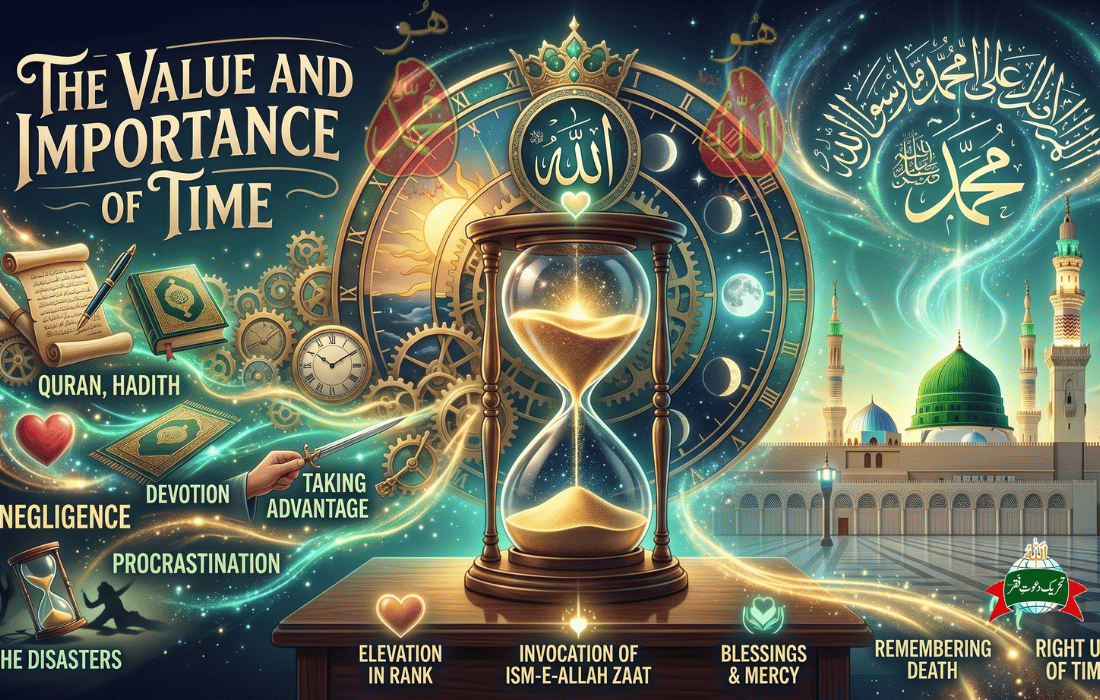
Allah has bestowed countless blessings upon man that cannot be fully encompassed, but the most important of these blessings is time. No other blessing, such as gold, silver, diamonds, etc. can compare to time. For example, after losing worldly wealth, there is hope and possibility that a person can regain it, but time is such wealth that if it is lost once, then no wealthy or powerful person in the world can bring it back.
WHAT IS TIME?
Time is the field of life and human existence, the arena for survival, gaining benefits, and rendering benefits.
Some lexicographers have described the components of the definition of time in books. In this respect time is not the name for an epoch; rather, an epoch is relative to time. Time is the name for a known quantity of an epoch. In Lisan-al-Arab, Ibn Sayyid writes that time is the name for a well-known quantity of an epoch [Book: Tuhfa-e-Waqt]
When time is defined as a known quantity of an era it can be understood as the period during which we live in this world. Time itself is the substance of human beings and their life. Time is the amount of an era provided to a human, after which they migrate to the eternal world. Allah says in the Holy Quran:
Allah shall never grant respite to a soul when its appointed time (of death) has arrived. And Allah is All-Aware of what you do. (63: 11)
For each community, there is an appointed term. When their time comes, they shall not delay it by a single hour, nor shall they advance it. (7: 34)
IMPORTANCE OF TIME IN THE LIGHT OF THE QURAN:
Allah Almighty has sworn by different times in many places in the Holy Quran, which highlights the immense importance of time because Allah does not swear by anything which is not important. Allah says in Surah Al-Fajr:
By the dawn, and by the ten nights. (89: 1, 2)
Allah Almighty has also sworn by the night and the day, saying:
By the night, when it covers (everything in darkness), and by the day, when it brightens, (92: 1)
In Surah Ad-Duha’s swearing by the time of the forenoon and the night, Allah the Almighty said
By the morning brightness, by the night, when it calms and covers (the daylight with its darkness). (93: 1)
Allah Almighty has said in Surah Al-Asr,” swearing by time. He says:
By Time! Indeed, humans are in (great) loss (for he is losing the most valuable commodity of his life). (103: 1)
In the aforementioned blessed verses, Allah Almighty has sworn by dawn, morning, forenoon, night, day and time. It is Allah’s dignity that He does not swear by anything trivial. Therefore, the oaths He has taken by different times are not a small matter; rather, through them, we are warned not to consider the times of our lives as trivial and worthless, as we will be held accountable for its every single moment on the Day of Judgement.
IMPORTANCE OF TIME IN THE LIGHT OF HADITH:
It is narrated from Abdullah bin Abbas (RA) that the Holy Prophet (pbuh) said:
There are two blessings in which many people incur loss: health and free time…. [Sahih Bukhari: 6412.]
Amr bin Maymun al-Awdi (RA) narrates that the Messenger of Allah (pbuh) advised a man, saying: “Take advantage of five things before five: your youth before your old age, your health before your illness, your wealth before your poverty, your free time before your preoccupation, and your life before your death. [Mishkat al Masabih, 5174]
Despite this, a large number of the general public and elite are wasting time, and this is a great loss for the nation and individuals.
The Prophet (pbuh) said:
The son of Adam will not be dismissed from his Lord on the Day of Judgement until he is questioned about five things: His life and how he lived it, his youth and how he used it, his wealth and how he earned it and he spent it and how he acted on his knowledge”. [ Jame al-Tirmidhi, 2416]
Man will be questioned generally about his life and specifically about his youth, even though youth is a part of life, but it has a prominent status as the age for achieving things. This is the age of determination and courage to achieve things, and it is a stage of strength and power between two weaknesses: childhood and old age. As Allah says in the Holy Quran:
Allah is the One Who created you from a state of weakness. Then He gave (you) strength after weakness. Then, after (your) strength, He gave (you) weakness and old age. He creates whatever He wills. And He is the All-Knowing, the All-Capable. (30: 54)
IMPORTANCE OF TIME AND GOLDEN SAYINGS:
Abdullah bin Mas’ud (RA) says:
I am not as regretful about anything as I am on a day on which the sun set, my life decreased, but my (good) deeds did not increase.
He further said: Indeed, I do not like a person whom I see idle, not engaged in any worldly work nor any work for the Hereafter.
Abu al-Qasim Nasrabadhi says:
“Taking care of your time is one of the signs of being mentally alert”.
Imam Shafi says:
Time is like a sword; if you do not cut it (spend it) with some work, it will cut you.
Imam Ibn al-Qayyum says, “When Allah intends goodness for a servant, He helps him through time and makes time a supporter for him. And when Allah intends evil for someone, He makes time an opponent against him and makes time narrow for him. whenever he intends to walk, time does not support him. While the first person, whenever he intends to sit, his heart makes him stand up at that very moment and becomes his support”. [ Madarij-us-Salikeen]
Therefore, the person whom Allah Almighty engages in good deeds and who spends the precious moments of his life in His Obedience, surely there is no greater goodness and welfare for the servant than this. However, passing life in useless talks and tasks is the displeasure of Allah and the calamity of sins.
Khwaja Hassan Basri says: “A sign of Allah turning away from His servant is that He makes him busy in futile activities, just to humiliate him. [Jami’ al-Uloom wal-Hikam]
Yahya bin Mu’adh al-Razi (RA) said,” Wasting time is more dangerous than death, because wasting time distances one from the Truth, while death only distances one from creation.
The importance of time has been well highlighted in Sharia. That’s why a special time has been set for every action and order, which is actually an effective formula to make human beings bound to discipline. History is witness that success and victory always belong to those who are time-conscious and appreciative. Those who sit idle with their hands crossed and remain busy making castles in the air, neither do their dreams come true, nor does time remain in their hands. Someone has rightly said:
وقت از دست رفته و تیر از کمان بسته باز نیاید
Time passed and an arrow shot from the bow do not return.
AWARENESS OF THE DISASTERS CAUSED BY WASTING TIME:
There are many calamities that waste a person’s time and consume his life, especially when one is unaware of their severity. These calamities are as follows:
NEGLIGENCE:
This is a disease that affects a person’s heart and mind in such a way that he loses awareness regarding the accidents and events occurring in the world, and the passage of days and nights, and becomes careless about the outcomes of different affairs. Therefore, his centre of attention is the appearance (physical), not the soul, and their gaze leaves the truth and settles on the outwards, leaves the essence and settles on the shell, and leaves the final consequences and settles on the beginning. The Holy Quran has warned with full intensity in various places about the gravity of this disease of heedlessness to the extent that the neglectful has been declared fuel for Hell. Allah says in the Quran:
We have indeed created for Hell many of the jinn and humans: they have hearts with which they do not understand; they have eyes with which they do not see; and they have ears with which they do not hear. They are like cattle; rather, they are further astray. It is they who are heedless. (7: 179)
In Surah Al-Kahf, Allah Almighty said:
Keep yourself patiently in the company of those who call upon their Lord morning and evening, desiring His Countenance (i.e. His pleasure). And do not turn your eyes away from them, desiring the attractions of this world’s life, nor follow the one whose heart We have made negligent of Our remembrance, who follows his low desires and whose affair exceeds (all) bounds. (18: 28)
Negligence is a very big calamity. As a result, today the condition of the Muslim umma has come to such a state that it is going through such major accidents which (would shake) mountains, but the state of indifference of our umma is such that it neither learns any lesson from them nor brings any change within itself. Negligence has reached such an extent that despite witnessing everything, it does not even move.
THE HABIT OF PROCRASTINATION:
The habit of procrastination is an extremely dangerous habit that wastes a person’s time. This habit never allows a person to benefit from time, instead, they become so accustomed to delaying their tasks that the word ‘tomorrow’ becomes their motto, and as a result, the person becomes a failure.
Khwaja Hasan al-Basri says:
Avoid procrastination because your connection is with today and not with the coming tomorrow. And if you do get that tomorrow, treat it the same way you treated today. And if tomorrow does not become yours, you will have to regret the shortcomings of today.
Procrastination in good deeds makes the human soul accustomed to abandoning them, and when this habit becomes rooted within the person, it becomes a second nature that is very difficult to overcome. The situation reaches a point where, although the person is intellectually convinced that it is necessary to obey Allah and His Messenger and to hasten towards righteous deeds, they do not find enough firmness in their resolve to help them perform these acts. On the contrary, they feel a kind of lethargy and aversion to action within themselves, and if one day they take a step towards a good deed, it feels as if a mountain has been placed on their back.
CRITICISING OR ABUSING TIME:
Islamic teachings forbid condemning time, as condemning time is equivalent to condemning its Creator. This act is prohibited because it equates to insulting the Creator of the universe. This matter is clarified in the Prophetic Hadith:
Abu Huraira narrated that the Messenger of Allah (pbuh) said:
Allah Almighty said: The son of Adam abuses Me. He curses time and I am time, for in my hand is all authority and I alternate the night and day. [Sahih al-Bukhari: 4826]
Complaining about time, blaming it, or speaking ill of it is among the major causes of wasting time. This is a form of heedlessness that prevents people’s consciences from awakening. Through their actions, people demonstrate that time is their greatest enemy and the biggest obstacle in the path of their hopes. But this unfortunate person is ignorant of the fact that time has no relation to fate, rather time is tied to the adoption or abandonment of causes. Abusing time leads to its distance and deprivation from the path of truth.
BAD COMPANIONSHIP:
The important means to make life successful is the companionship of good people. If you sit with good people, onlookers will consider you good too even if you are not particularly good. Human beings are greatly influenced by the companionship of their peers, and as a result, a person either engages in bad deeds or wastes time. Companionship affects a person’s faith, just as the Prophetic Hadith says:
“A man is upon the religion of his friend, so let one of you look at whom he befriends. [Jame at-Tirmidhi: 2378]
CONSIDERING ONESELF BEYOND THE GRASP OF ALLAH:
In reality, Allah Almighty has bestowed a great reward on humans in the form of leisure and time, health and youth. Man is immersed in these blessings, and intoxicated by these blessings, he forgets that these blessings can also decline. He considers himself free from the grasp of Allah Almighty and wastes them, and does not appreciate them.
FORGETTING DEATH:
Remembering death is an act that prevents making life useless and wasting time, and death has a major role in this. The person who remembers that I will die will worry about his time and act to make his life useful because the remembrance of death motivates humans towards goodness and encourages them to avoid futile activities.
DEADLY POISONOUS ACTIONS:
Today in our society, where there are many new inventions and it is the era of technology, besides their benefits, there are also disadvantages that have been adopted in society, such as unnecessary use of the internet, addiction to social media, watching movies and programmes containing obscenity and vulgarity, addiction to video games and mobile games etc.
THE RIGHT USE OF TIME:
What lifestyle should we adopt to use time correctly and avoid wasting it?
Therefore, the life of the Prophet Muhammad (pbuh), his Companions, and the righteous Sufis among his umma are the best example. The Holy Prophet (pbuh), during his 23-year blessed life after prophethood, made the entire Arab world bow before one Allah and delivered the message to all four corners of the world.
When reading the accounts of the Rashidun Caliphs (may Allah be pleased with them), we find that they suppressed the fitna (trials) of false prophets, apostasy, Zakat deniers, and the Khawarij in a short period of time. Along with this, they strengthened the Quran’s compilation, promoted knowledge and economy, and established a society based on piety and purity, while strengthening Islamic borders militarily, they spread the faith far and wide across the continents of Europe, Africa and Asia.
Then when you observe the conditions of the Companions, the trained Tabiun, Taba Tabiun, jurists, and the pious Hadith scholars, commentators, and jurists, you find that some of them were so devoted to worship and spiritual exercises that they spent the entire night crying, praying, and reciting the Quran. Some of them excelled in knowledge so much that each of them authored dozens of books on Tafseer, Hadith, Fiqh, History, law, literature, and various arts and sciences.
The purpose of human creation is declared to be servitude and recognition of the Creator of the universe”. This is the purpose of every human’s creation. If one is a Muslim the responsibility increases compared to other people, because for any Muslim, the purpose along with servitude to Allah and following Prophet Mohammad (pbuh) also becomes the establishment of Islam over all religions.
If we study the blessed life of the present Imam of the Sarwari Qadri order Sultan-ul-Ashiqeen Sultan Mohammad Najib-ur-Rehman, then the correct use of time” appears as a very prominent aspect of his personality. In his view, “time” is a great trust given by Allah, which should be spent only for attaining the pleasure of Allah and the welfare of humanity.
Following are the important aspects of valuing time from the daily life of sultan-ul-Ashiqeen:
- All the affairs of Sultan-ul-Ashiqeen are managed on an order and time, whether it is a matter related to Allah Almighty, the training of disciples, or the work of writing and composing, he performs every task at its designated time. Seeing this discipline of his, the disciples also feel the importance of time.
- He is a Universal Divine Man of this era, and as such has overwhelming engagements, but despite this, in his limited time, he has authored 24 books.
- Sultan-ul-Ashiqeen often wakes up at night to pen down the true teachings of Islam and Faqr.
- Sultan-ul-Ashiqeen’s staying away from time -wasting activities is the reason why he was able to author so many well-researched books to the Muslim umma.
He spent a large part of his time organising Tehreek Dawat-e-Faqr. He devised a modern system instead of the traditional system so that as many people can benefit from the teachings as possible. This includes:
- The use of social media, websites and digital libraries which ensured time savings and expanded the scope of work.
According to the teachings of Sultan-al-Ashiqeen the best use of time is to spend it in the servitude of God.
He says, that any moment spent without the remembrance of God is wasted.
He also taught his disciples the invocation and contemplation of Ism-e-Allah Zaat so that through it, they remain inwardly connected with Allah every moment, even while doing worldly work, the best use of time (the remembrance) continues.
There is no room for futile conversation or backbiting in the assembly of Sultan-ul-Ashiqeen since time is spent either in conversation regarding the issues of Faqr or in the spiritual guidance of people. He prefers silence and speaks only when necessary, which is an excellent ways in to save time.
CONCLUSION:
Sultan-ul-Ashiquen’s life is a practical explanation that if a person utilises his time granted by Allah wisely a lot can be achieved in a short span of time. Because time is the only wealth that cannot be earned back, it should be spent solely in seeking the pleasure and closeness of Allah.
REFERENCES::
- Life and time: Author: Abu Muhammad Uzair Younus
- Value of Time: Author: Shaikh Shafiq-ur-Rehman
Note: This is English translation of Urdu وقت کی قدروقیمت article that was published in May 2026 issue of the monthly Sultan-ul-Faqr Magazine. Mrs Noreen Sarwari Qadri wrote the original article. Zahid Anjum Siddiqui has translated it in English.
Tehreek Dawat e Faqr Copyright 2025 - All Rights Reserved

Leave Your Comments